
Floyd County VINELink Is Now IVSS
Texas replaced VINE for county custody notifications with the Integrated Victim Services System for Counties, or IVSS-Counties, effective September 1, 2025. The Texas Attorney General transition notice is the authority for that change. Existing registrations moved to the replacement provider, and users were told to update credentials for portal access. Phone and text notification could continue.
The legacy VINELink name remains familiar and appears in this page's search phrase, but the current county portal is IVSS-Counties. State-prison and parole notifications use the separate TDCJ IVSS portal. Old Floyd County links that point to VINELink should not be treated as the present destination.
Floyd County participation was not conclusively established by a fixed authoritative county list. Confirm coverage in the live portal or through IVSS support. Current materials publish 866-268-8959 for round-the-clock English and Spanish support. Portal coverage and an official jail record are still different things.
Current-system warning: Use IVSS, not the old VINELink site, and confirm a reported event with the jail because the portal is not an official record.
Search a Floyd County Inmate
Begin with the receiving jail. Floyd County's jail closed in 2003, so a Floyd arrest may produce a Sheriff transport record followed by another county's booking. Childress County is a documented destination in a recent report, not a permanent destination for every person. Ask Floyd County where the person went.
- Collect the full legal name, date of birth, arrest date, and any DOC, SID, jail, or permanent booking identifier.
- Open IVSS-Counties for county custody. Search a full or partial name or use the available identifier.
- If spelling is uncertain, the portal suggests a fuzzy search using the first three letters of each name. Review all plausible results.
- Open a record only after matching the reporting agency and more than one identifier. A photograph alone is not enough.
- Record the displayed custody event, agency, identifier, and update time exactly as shown.
- Call or write the reporting jail to ask whether the event was community release, transfer, or another form of custody change.
Use statewide TDCJ IVSS instead when the person entered a Texas prison or is under TDCJ parole supervision. County and state portals do not promise identical data. The full Floyd County release search adds the Sheriff transport, receiving-jail record, and court disposition needed for a sound conclusion.
What Floyd County IVSS Shows
IVSS is built for person-specific custody search and notification. It is not a complete released-inmate archive or a rolling Floyd County release feed. The county portal warns that people no longer in custody may not appear and that its information is not an official record.
| Field or event | How to use it |
|---|---|
| Reporting agency | Identifies the participant that supplied the event; verify that it is the actual receiving jail |
| Custody status or event | Describes the reported change but may require the jail's code definition |
| DOC, SID, jail, or booking ID | Helps distinguish people with similar names and join records across agencies |
| Event date | Agency-reported event date, which should be checked against the release sheet |
| Notification time | Time the alert was sent, not necessarily the time physical custody ended |
| Facility or supervision source | Shows which system supplied the information, not every later custodian |
A “release” event does not by itself prove dismissal, innocence, completion of the sentence, freedom from supervision, or absence of a transfer. Ask for the release sheet, reason code, and destination. If another custodian is named, follow that agency's system.
If no record appears, test spelling and identifiers, verify live participation, and contact the receiving jail. Older history, refresh timing, or departure from custody may explain an absence. None of those possibilities is affirmative proof.
Register Floyd County Release Notifications
Registration should follow the current IVSS screen because available delivery routes and confirmation steps can change. Select only the verified person and reporting agency. Save the confirmation without exposing private profile information.
- Open the matching IVSS record and choose the notification option shown by the portal.
- Select among the phone, text, email, or other routes offered on the live screen.
- Provide the contact details the system requests and complete account or contact confirmation.
- Review which events are covered, such as release, transfer, or another custody change.
- Save the registration confirmation and test or update migrated credentials if the registration began under VINE.
- Recheck the registration when the person moves to a different jail or enters TDCJ custody.
The current IVSS-Counties registration page is the proper source for today's workflow.
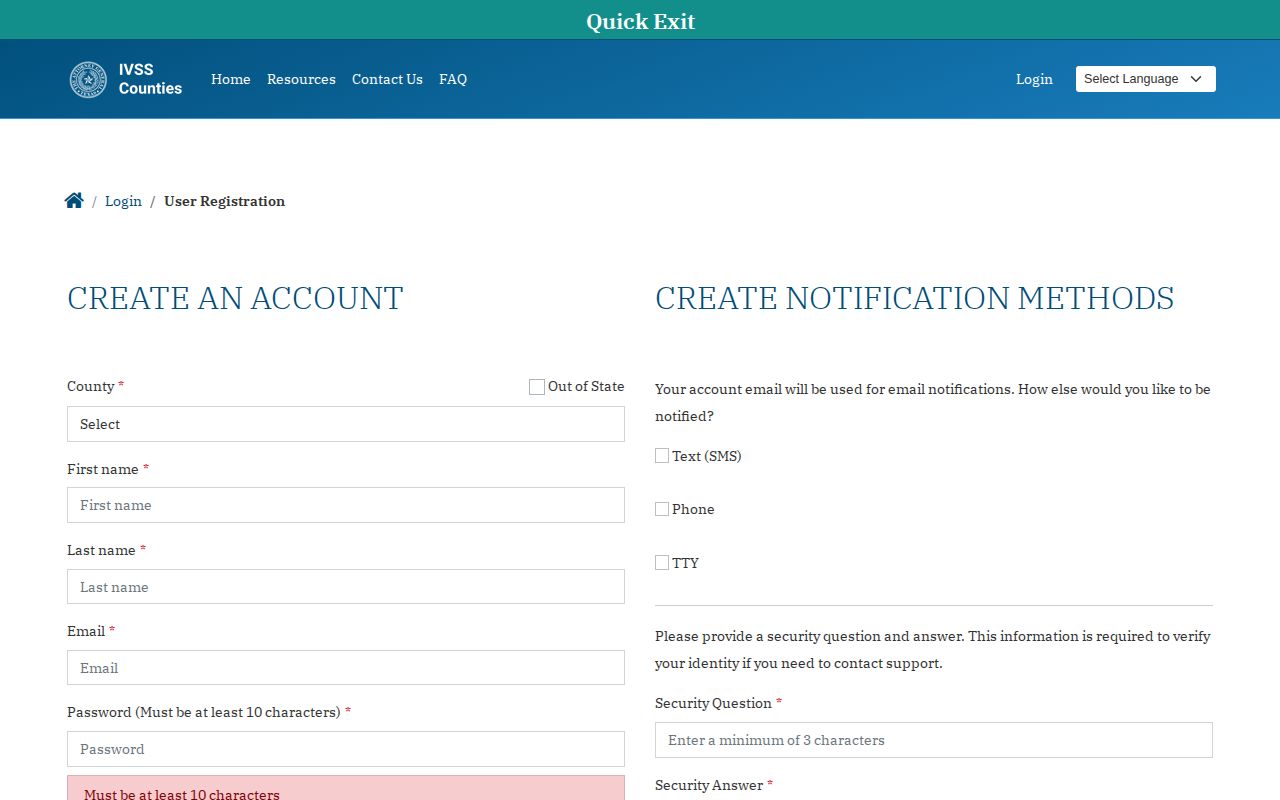
The captured registration entry reinforces that current screen instructions, not an old VINE fact sheet, control account confirmation and delivery choices.
Legacy Texas VINE telephone instructions used a four-digit PIN, entered during an automated call to confirm receipt. Calls could repeat until confirmation. That is historical context only. Do not promise that current IVSS web registration uses the same PIN step, and never publish a PIN, password, phone number, or private alert profile.
Join Floyd County Custody Records
The strongest Floyd-specific method is a custody-chain join. The Floyd Sheriff's arrest and transport file supplies the destination. The receiving jail's booking number ties that person to admission and release data. The release or transfer code then connects to the court record or next custodian. This method compensates for the absence of a Floyd County jail roster.
- Ask the Floyd County Sheriff for the arresting agency, incident or booking number, transport date, and receiving facility.
- Give that destination jail the name, arrest date, and transport details. Request its booking number and custody event.
- Obtain the release date and time, exact reason code, destination, and any public detainer notation.
- Compare the result with the Floyd court's bond order, dismissal, judgment, commitment, or later order.
- If the destination is TDCJ, ICE, another county, or federal custody, continue in that system rather than describing community release.
A court order may authorize release before the jail completes it. An IVSS alert may arrive after the physical event. Preserve all three timestamps and say what each represents. That avoids turning a transfer into a false release claim.
Note: The only sound final statement is as narrow as the source, naming the custodian, recorded event, time, reason, and destination when available.
Confirm a Floyd County IVSS Event
Read the source hierarchy in order. IVSS gives a notification lead. The receiving jail owns the county custody record. The Floyd court supplies legal orders and disposition. TDCJ owns state-prison and parole records. These systems can show different dates without contradicting each other.
Ask the jail for its release sheet, booking sheet, custody history, transport log, and code legend. If the person left the jail for another agency, state “released from this agency to the next custodian, so still in custody.” If the jail documents community release, retain its timestamp and reason. If TDCJ shows parole or mandatory supervision, state that confinement ended but supervision remains.
The IVSS county search screen is a useful starting point for a Floyd County release alert.
Open the official IVSS-Counties source before using the captured interface.
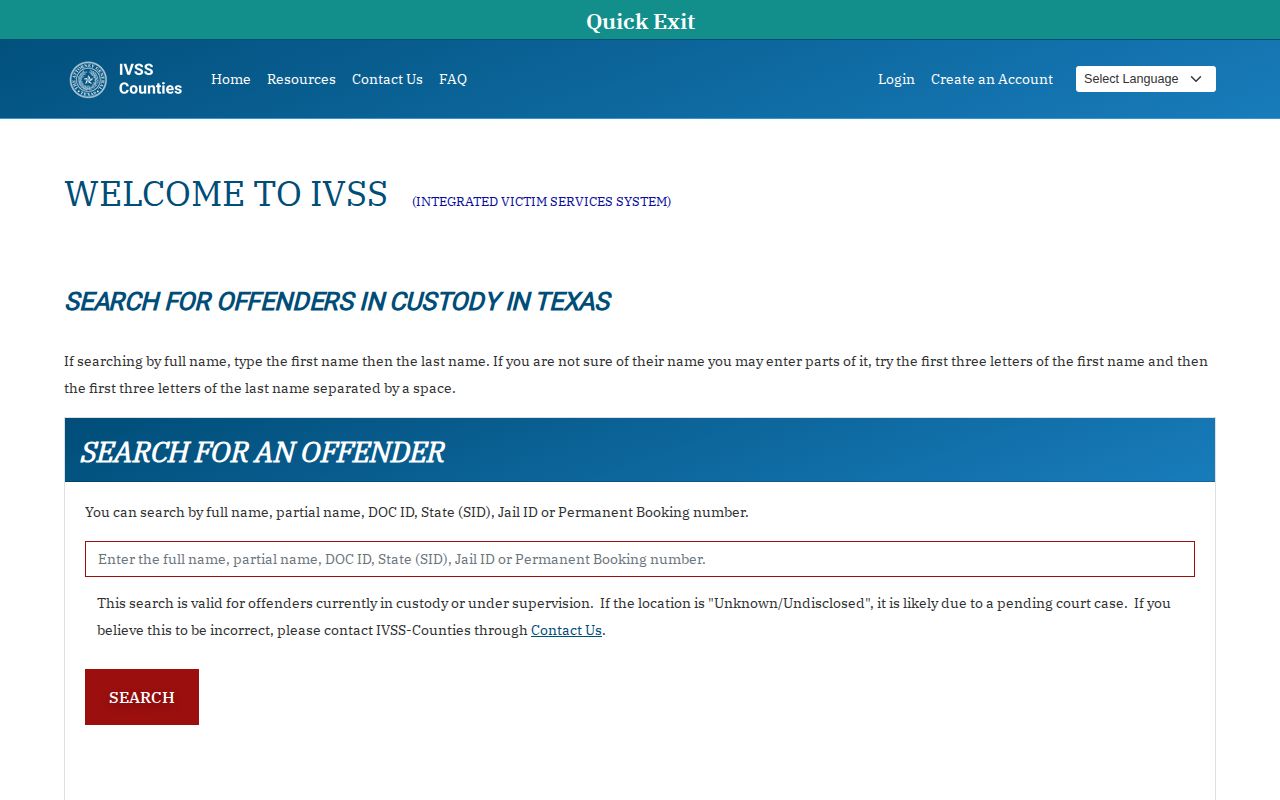
The screenshot shows the current county-system entry, while the custodian's record remains necessary to prove what happened.
Floyd County IVSS Coverage Limits
IVSS does not replace every custody system. The county portal covers participating county sources. TDCJ IVSS serves the state-prison and parole context. Neither is the federal Bureau of Prisons locator, the ICE detainee locator, or a U.S. Marshals custody-history service.
| Situation | Correct channel |
|---|---|
| Floyd arrest sent to a county jail | Floyd transport record, receiving jail, and IVSS-Counties if that source participates |
| Texas prison or TDCJ parole | TDCJ search, information channels, and statewide TDCJ IVSS |
| Federal sentence | Bureau of Prisons Inmate Locator and BOP records channels |
| County release to ICE | ICE locator or Enforcement and Removal Operations; the county event is a transfer |
| Floyd court outcome | County or District Clerk and statewide court search |
Data feeds can lag. A notification timestamp may be later than the jail event. A person can also disappear after leaving the participating agency. Never rewrite either condition as a completed community release without the originating record.
The Texas DPS sex offender registry is also separate. It covers only people with a statutory registration duty and cannot serve as a general list of released people or proof of a jail release date.
Floyd County Release Alert Privacy
Keep the search focused on the right person and event. Match independent identifiers and avoid sharing a birth date, home address, victim information, notification routes, passwords, or PINs in screenshots or messages. A staged search is safer than publishing unnecessary personal details.
Log the official URL, date checked, reporting agency, event text, and any follow-up contact. If staff gives a code definition, preserve it. If the destination remains unresolved, say so instead of supplying a likely answer.
Notifications are useful for timely awareness and for reducing repeated checks. They do not create a court-certified custody history. Verify each event with the agency that made it.
Public Record Search
Sponsored Results