
Floyd County Three-Day Release Source
No official Floyd County 72-hour release feed, current roster, or archive was found. The local jail closed in 2003 and was later demolished. The Floyd County Sheriff's Office can supply arrest and transport facts, yet another county may hold the person. That destination jail creates the admission and physical-release event.
A neighboring jail's page cannot be relabeled as a Floyd County list. Recent local reporting documents transport to Childress County in at least one matter, but that fact proves only a real example. It does not establish an exclusive housing arrangement. A three-day review may involve Childress, another receiving county, TDCJ, or a federal custodian. Ask Floyd for each destination within the exact range before searching elsewhere.
Do not combine unrelated agencies into one inferred list. A receiving jail may also hold people arrested by many counties, while a Floyd detainee may go somewhere else. The Floyd transport record supplies the joining fact. Once the destination is known, use that jail's own booking number and event time. This preserves which office created each part of the chronology and avoids counting a transport as both a release and a new arrest.
Check Floyd County 72-Hour Releases
Define the interval before calling or writing. Use Central Time, state the inclusive starting and ending timestamps, and keep the same window in every request. A period described only as “the last three days” can shift while agencies process it. If the purpose is to locate one person, add the full name, date of birth when appropriate, arrest date, and any case or booking identifier.
- Ask Floyd County for arrests, transports, releases, and receiving facilities during the set interval.
- Separate local citation or bond release from transport to a jail outside Floyd County.
- Send each receiving jail the same interval and request admission, release, transfer, reason, destination, and booking identifiers.
- Check IVSS-Counties for the person, but verify any event with the reporting jail.
- Reconcile the result with the case court and any named next custodian.
The Released Last 24 Hours page narrows the process to same-day events. Use the Floyd County released inmate search when tracing one known person across a longer span.
Floyd County 72-Hour Record Fields
Floyd County does not display a three-day results table. These are request fields drawn from the local custody chain. Asking both Floyd and the receiving jail for stable identifiers allows the records to be joined without assuming that two similar names represent the same booking.
| Field | Use in a three-day review |
|---|---|
| Arrest or incident number | Anchors the Floyd agency record. |
| Transport date and destination | Identifies when and where local custody moved. |
| Receiving-jail booking number | Links the transport to a jail admission. |
| Release date and time | Shows when that facility's custody ended. |
| Reason or disposition code | Separates bond, sentence, court order, and transfer. |
| Destination and detainers | Shows whether another custodian took control. |
Request the code legend. “Release” can be an umbrella system label. A transfer to TDCJ, ICE, another county, or the U.S. Marshals Service is not a release to the community. When the destination is blank, do not fill it with a likely answer. Ask the record custodian to clarify what the field or code means.
Floyd County Weekend Release Timing
A 72-hour window is most useful when office closures or data refresh cycles break up a same-day search. It can cover Friday-to-Monday activity in one request. Still, no Floyd-specific weekend or holiday release schedule was found. Since Floyd County does not operate the jail, the actual receiving sheriff's procedure controls county-jail processing.
Texas Code of Criminal Procedure Article 43.13 generally places discharge of a county-jail sentence between 6 a.m. and 5 p.m. on discharge day. It also permits limited preceding-day or overnight routes under stated conditions. That statewide rule is not proof of a particular Childress pickup time or an automatic early release. For TDCJ, Government Code Section 501.016 permits a preceding-workday release when the date falls on a weekend or legal holiday. TDCJ rules do not govern a receiving county jail.
Ask the relevant facility for the scheduled date, release desk, property process, detainers, and weekend practice. Then record the actual event time. An authorization on Friday and a physical exit on Saturday are two separate facts.
Request Floyd Three-Day Release Data
A Public Information Act request can seek existing electronic data for the interval. Ask Floyd County for arrest, transport, and destination records. Ask each destination jail for admissions, releases, transfers, reason codes, destination fields, and booking sheets in the same range. Narrow fields and dates help the agency locate responsive records and can reduce cost.
Government Code Chapter 552 governs access subject to exceptions. Request native electronic copies and definitions for coded values. If the agency withholds material, ask for the legal basis. Section 552.301's ten-business-day rule concerns an agency seeking an Attorney General withholding decision; it is not a delivery promise. An estimate above $40 requires an itemized statement under Section 552.2615.
Keep the request focused on existing records instead of asking staff to make a legal conclusion. A useful sentence asks for the date and time physical custody ended, the agency's exact release or transfer reason, the destination, and definitions for all codes. If a jail provides only today's roster, ask whether its jail-management system or preserved report can return events for the stated interval. When no record is found, confirm the names, identifiers, and timestamps searched before treating that reply as final.
- Release
- Physical custody ends with no next custodian shown, subject to other causes.
- Transfer
- One agency ends custody because another agency takes it.
- Detainer
- A hold or request from another authority that can prevent community release.
- Discharge
- Completion of the sentence or supervision obligation shown by that system.
Why Floyd Lacks a 72-Hour Roster
The absence is structural, not a brief retention setting. Floyd County's jail closed in 2003, and its old building was demolished in 2016. Some directories still attach “jail” to the Sheriff's address, but the site is a law-enforcement and records contact. There is no authentic Floyd rolling 72-hour view to save or refresh.
The reliable substitute is a custody-chain join. First obtain Floyd's transport destination. Next match it to the receiving jail's booking number. Finally match that jail's exit code to the court or next custodian. This method catches events across the full three-day period while avoiding the false conclusion that disappearance from one agency equals freedom from all custody.
The official Floyd Sheriff contact page provides the starting point shown below.
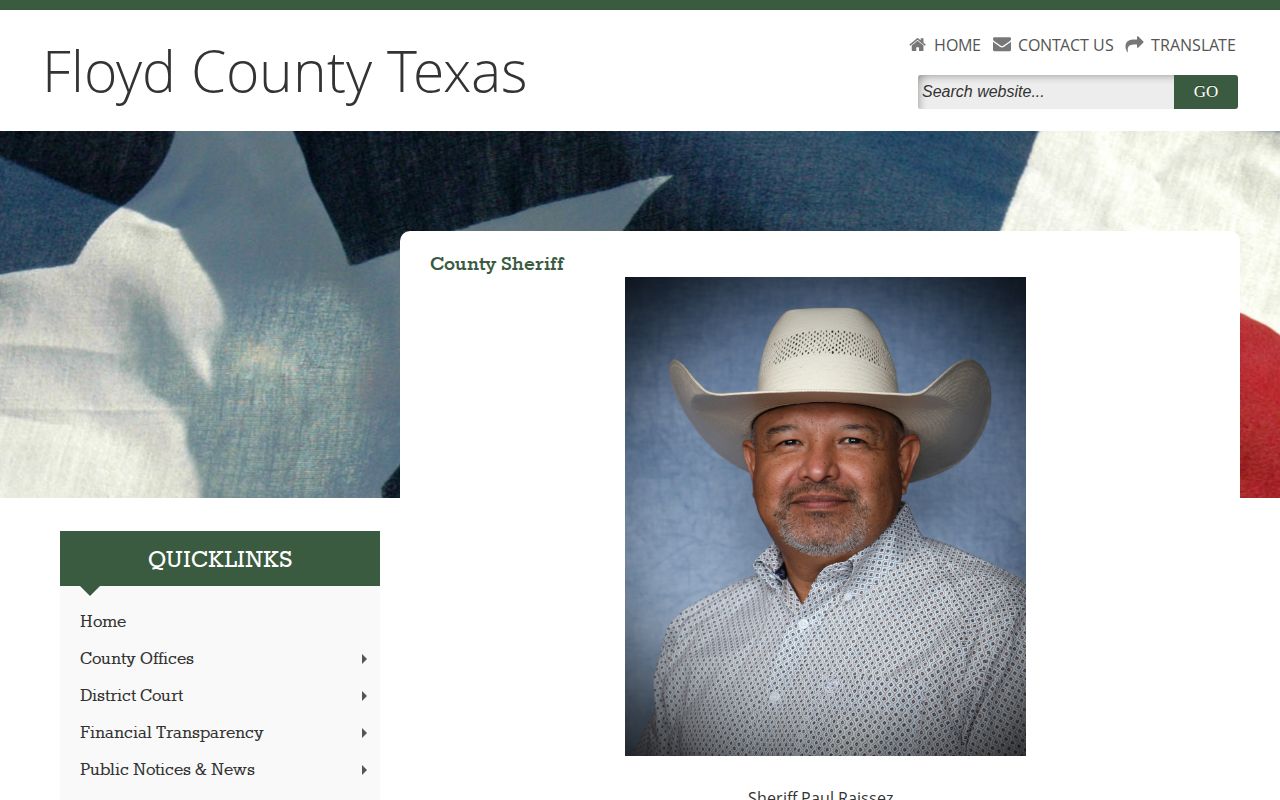
Use the Sheriff to identify every receiving jail in the interval, not as a substitute for those jails' release records.
Verify Floyd County Release Outcomes
IVSS-Counties can report a custody event from a participating source. It warns that its information is not an official record and that people no longer in custody may not appear. A missing result can reflect system coverage, name spelling, refresh timing, older history, or an agency change. It does not prove release. A positive event also needs its reason and destination checked.
The court file explains authority such as bond, dismissal, judgment, or commitment. Use the official Floyd County Clerk or Floyd County District Clerk based on the case. The jail record proves the physical custody event. A sound finding says “released to the community” only when the custodian records that outcome. For transfer, state that the person left one agency for the named next custodian and remained in custody. For TDCJ parole or mandatory supervision, say release from confinement into supervision. If the destination cannot be resolved, preserve that uncertainty.
Compare timestamps without forcing them to match. A judge may sign an order before jail staff verify other causes and complete processing. A notification may be sent after the physical event. Record each time with its source and label. Where two agencies disagree, quote the official fields and ask both custodians to explain the difference rather than choosing the faster or more convenient result.
Note: Keep the source URL, access date, office contacted, request text, response date, and any redactions with the three-day record.