
Floyd County Parole Versus Probation
Parole is release from prison before the sentence fully expires, subject to rules and supervision. The Texas Board of Pardons and Paroles decides parole and mandatory-supervision matters. The TDCJ Parole Division then investigates a release plan, completes processing, and supervises the releasee. A favorable Board vote is not the physical-release event. Audits, program requirements, a release certificate, and placement work may remain.
Probation, called community supervision in Texas, is ordered by a court. It may begin without a prison stay. The Floyd County Community Supervision and Corrections Department, or CSCD, handles local adult community supervision, but a transfer may put day-to-day reporting elsewhere. Neither status is shown by a county jail roster, and Floyd County has had no operating jail since 2003.
| Point | Parole or mandatory supervision | Probation |
|---|---|---|
| Source | TDCJ prison case and Board action | Court judgment or supervision order |
| Agency | Board decisions; TDCJ Parole Division supervision | CSCD named in the active case |
| Release meaning | Out of confinement but still serving a supervised term | May follow jail release or may avoid confinement |
| Best proof | TDCJ status, release record, and active office | Court order and confirmation from the supervising CSCD |
- Parole
- Conditional release from prison before sentence expiration.
- Mandatory supervision
- A supervised TDCJ release governed by statutory eligibility and Board rules.
- Community supervision
- The Texas term commonly used for adult probation ordered by a court.
- Discharge
- The documented end of the sentence or supervision shown by the responsible agency.
Verify Floyd County Release Supervision
Start with identity, not an office guess. Obtain the full legal name, date of birth, TDCJ number or State Identification number when available, court case number, and county of conviction. A similar name is not enough. The Floyd County conviction record may explain the sentence, while TDCJ establishes state-prison release status and the CSCD establishes probation.
- Check the TDCJ inmate search when a state-prison sentence is possible. Match age, offense, county, and identifiers.
- If the public search has no result, use the TDCJ information channels. The online search covers current TDCJ inmates, not a full public archive of former prisoners.
- Record the official label: parole, mandatory supervision, discharged, incarcerated, or another status. Do not replace it with a looser term.
- Use the Parole Division directory to locate the office responsible for the active case.
- For probation, obtain the judgment and later orders, then use the Texas CSCD directory and ask which department currently supervises the order.
- Confirm any warrant or absconder claim with the issuing court or agency before drawing a conclusion.
The custody record and supervision record answer separate questions. A receiving county jail can prove when it ended physical custody. TDCJ or the CSCD proves whether supervision followed. The full Floyd County release search and records path is described on the Floyd County released inmates home page.
Important: A parole approval, court order, or missing jail-roster entry does not prove the person physically left custody. Obtain the releasing agency's event and destination.
Floyd County Supervision Office Routing
Floyd County does not have one public online screen that combines parole, mandatory supervision, probation, warrants, and discharge. The responsible office depends on the source of the sentence and the current supervision assignment. Use the directories below rather than sending every person to the courthouse.
TDCJ Parole Division
Official parole office directory
Use the assigned office shown by TDCJ. Approved
residence, transfer, and specialized caseload needs can
control placement.
Floyd County CSCD
CJAD community supervision directory
Confirm the active department from the court order and
current directory entry. Published hours and direct contact
details should be checked in the live listing.
For a Floyd arrest, the Sheriff's Office may identify where the person was transported, but it does not replace the parole or probation authority. The former Floyd County jail closed in 2003. A receiving jail owns its custody and release event, while the court, Board, TDCJ, or CSCD owns the legal supervision record.
Childress County is one documented destination in a 2025 activity report. It must not be treated as the permanent destination for all Floyd arrests. Ask the Sheriff where the specific person went, then connect that receiving jail's release code to the supervision record.
Note: Confirm directory details before relying on an office because reporting locations and case assignments may change after an intrastate or interstate transfer.
Where Floyd County Releasees Report
A conviction county does not guarantee a reporting office. TDCJ may approve a residence outside Floyd County. The active office may also change when a releasee moves, when supervision transfers, or when a specialized program controls the caseload. Probation can move between departments as well. That is why the correct question is “Which office supervises this person now?” rather than “Which office covers Floyd County?”
This Floyd County release supervision split is especially important because local custody is already decentralized. The Sheriff records the arrest and transport. Another county may book and release the person. A Floyd court may hold the case. TDCJ or a CSCD may then supervise the person in a different location. Match the same identifiers across each record and retain the distinct dates.
Ask the supervising agency to confirm only what its record supports: active or discharged status, supervision type, assigned office, and whether a transfer is pending. Do not infer a home address or current location from the county of conviction. Protected information should remain private.
Floyd County Parole Review Records
Texas does not hold formal public hearings for ordinary parole or mandatory-release consideration. The Board's parole-panel FAQ explains that three-member panels review and vote on files. If the first two voters agree, the result is final. If they differ, the third member votes. There is therefore no public Floyd County parole-hearing calendar to search.
The practical schedule is person-specific. TDCJ identifies cases before eligibility review, prepares a case summary, and supplies required notices. The official parole review process explains the sequence. Decision codes can reflect approval with conditions, denial and a later review, or later withdrawal or reopening. Copy the exact code and consult the Board's current definition.
The official review page illustrates the file process used for Floyd County parole matters.
View the Texas parole review source before reading the captured screen.
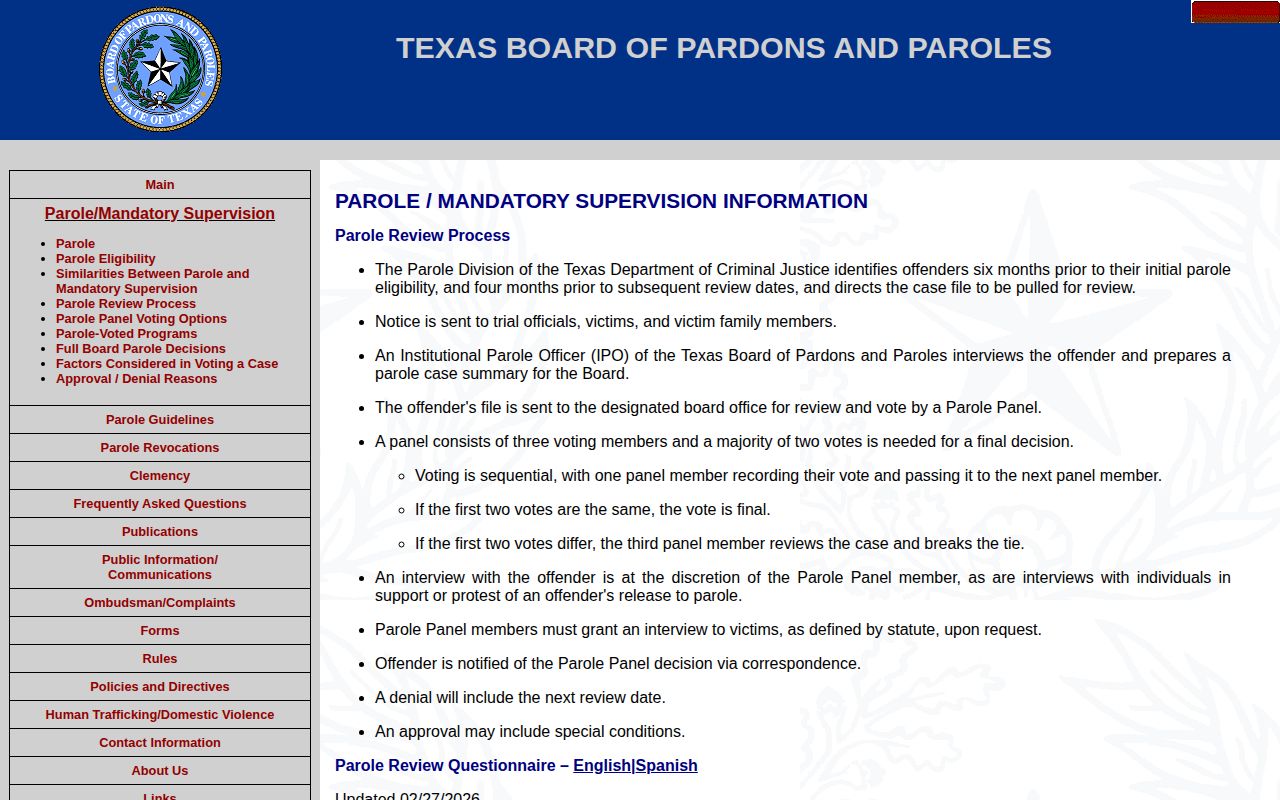
The image supports the distinction between a Board review result and the later TDCJ work needed for physical release.
Floyd County Violations and Warrants
Supervision conditions are the rules stated in the release certificate or court order. They can include reporting, travel limits, program participation, and other case-specific duties. A violation is an alleged failure to follow a condition. Revocation is a later legal or administrative action that can return a person to custody. These terms should not be treated as synonyms.
An absconder notation generally means the agency alleges that contact was lost or rules were not followed and may seek or hold a warrant. Floyd County has no verified public local absconder list or comprehensive online warrant list. TDCJ wanted material concerns state supervision. A local warrant must be checked with the issuing court or law-enforcement custodian.
One cause can end while another keeps the person in custody. Ask for the exact warrant, cause number, issuing authority, and status. If a jail releases a person to another agency on a warrant, that is a custodial transfer, not a community release.
Note: An old social post cannot establish current warrant, absconder, supervision, or discharge status; use the office that issued or maintains the record.
Floyd County Supervision Discharge
Parole release differs from discharge. A person on parole or mandatory supervision has left confinement but remains under an enforceable term. Discharge means the sentence or supervision obligation shown by that agency has ended. Probation ends through the court and CSCD record, not through a parole database.
Request the final document or agency response that gives the status and effective date. For TDCJ, use inmate/parole information or a public-information request if the public search no longer returns the former prisoner. For probation, ask the court and current CSCD for the order or completion record. Keep the document separate from the jail's physical-release timestamp.
Government Code Chapter 508 supplies Texas parole and mandatory-supervision rules. It includes eligibility limits, but eligibility is not release, and release is not discharge. A careful conclusion therefore says either “released from confinement to parole or mandatory supervision” or “discharged from the sentence or supervision shown by the agency.”
Public Record Search
Sponsored Results