
Floyd County Mugshot Record Limits
A booking photograph identifies how a person looked during one booking. It does not prove conviction, release, innocence, or ongoing detention. Floyd County's jail closed in 2003, and the former structure was demolished in 2016. The Floyd County Sheriff's Office may hold arrest and transport records, but no local roster, release-photo page, or booking-photo gallery was found.
Someone arrested in Floyd County may be booked by a receiving county jail. That jail, rather than Floyd County, may own the photograph and its access rules. Recent reporting documents Childress County as one destination in at least one case, but no source proves that every Floyd detainee goes there. Ask the Sheriff for the receiving facility and booking details before directing a photo request.
One person may have more than one booking image. Use the agency name, booking date, charge record, and stable identifier to distinguish them. A name-only match can join the wrong image to the wrong event, especially when a mirror has dropped the booking number. Preserve the source URL and access date with any copy, and do not publish more personal data than is needed to identify the correct booking.
Find Floyd County Released Mugshots
Photo discovery follows the custody chain. Start with the Floyd arrest or transport record. Once it names the booking agency, check that jail's official record access and ask whether its current or retained booking record includes a photo. If the person later entered TDCJ, the state prison system becomes a separate channel. Each source has a different purpose and retention range.
| Channel | Photo coverage | How to access |
|---|---|---|
| Floyd Sheriff | No public gallery found | Request arrest, transport, destination, and any agency-held booking image. |
| Receiving county jail | Depends on that jail's roster and policy | Confirm the booking, then request the booking sheet and photograph. |
| TDCJ | Public results may show available identifying material | Use the official search and public-information route; access is not guaranteed. |
| Texas DPS registry | Color photo for people required to register | Use only for its limited statutory registry population. |
| News or official social | Only selected events | Use as an event-specific lead, not a complete custody record. |
The Texas DPS Public Sex Offender Registry is not a gallery of all released people. It contains only people with a registration duty. Likewise, an arrest photo in a press release documents the event described there and cannot settle a later release question.
Request Floyd County Booking Photos
Texas calls the written route a Public Information Act request. Send Floyd County a narrow request for the arrest record, transport log, receiving facility, booking sheet, and booking photograph. Then send a parallel request to the jail that actually performed the booking. Include the full name, arrest or booking date, booking or incident number if known, and the specific image sought.
- Confirm the arresting agency and receiving jail with Floyd County.
- Identify the exact booking by number and date.
- Request an electronic copy of the booking photograph and related booking sheet.
- Ask for the statutory basis if the agency denies or redacts the photograph.
- Pair any image received with the official release, transfer, and court records.
Government Code Chapter 552 governs public-information access subject to specific exceptions. Code of Criminal Procedure Article 2.36 distinguishes a response to a Chapter 552 request from proactive internet publication. An agency's choice not to post a photo does not prove that no image exists in its files.
Floyd County Sheriff App Absence
No Floyd County jail-information mobile app was verified. Do not use a similarly named app for Floyd County, Georgia. The absence matters because some counties show booking photos in an app even when the main website does not. Floyd County supplied no verified local app route, and it has no operating jail roster to search.
The Floyd County Record publishes selected monthly sheriff narratives and may credit agency-supplied or social material. Those reports can identify an arrest date, arresting agency, or transport destination. They are not a full custody ledger. A post's deletion or the absence of a follow-up story cannot confirm release, dismissal, expunction, or photo removal.
The official Floyd Sheriff page shown below is the records and destination starting point, not a photo gallery.
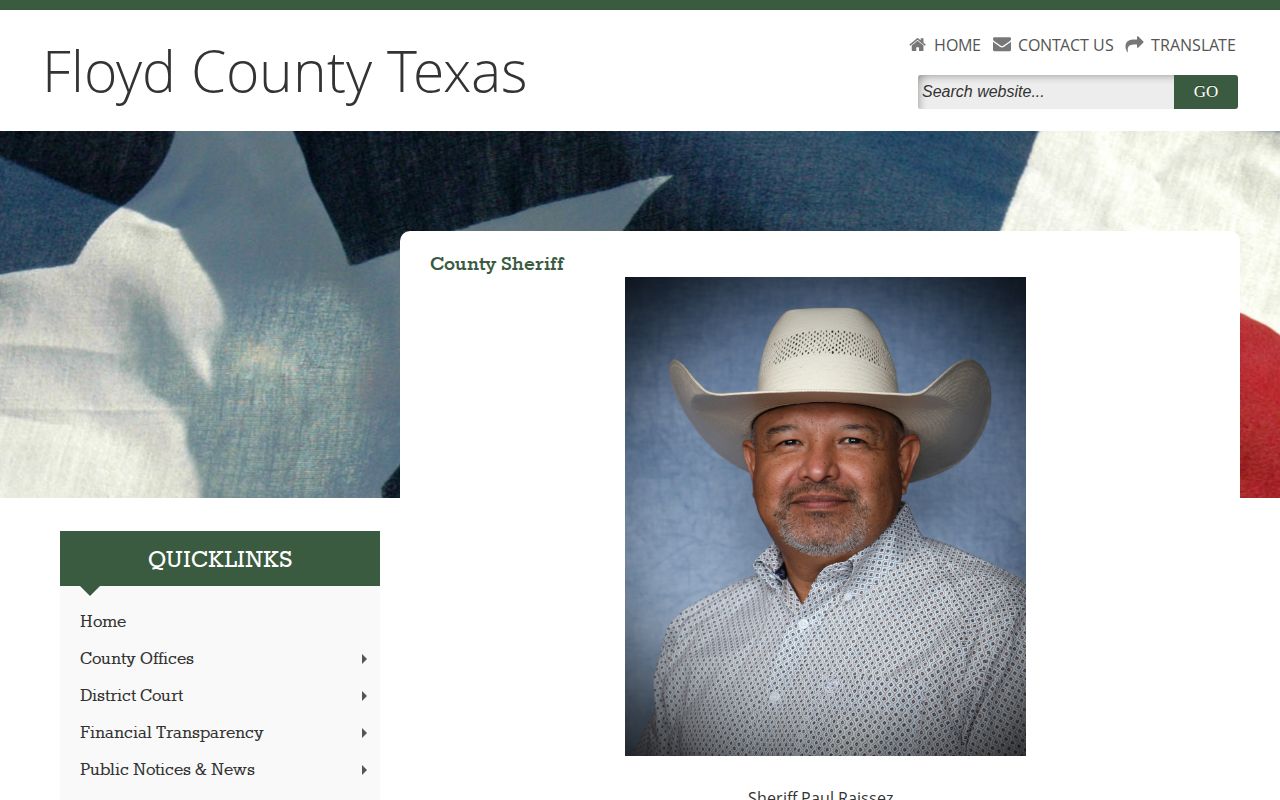
Use the contact to identify the booking agency, then ask that custodian for the photograph and custody outcome.
Texas Mugshot Publication Rules
The lack of an official Floyd mugshot gallery has both operational and legal context. There is no local jail feed, and Texas Code of Criminal Procedure Article 2.36 generally restricts proactive law-enforcement publication of mugshots. Stated exceptions include conviction for the conduct, a fugitive or public-safety determination, a court order, certain death or capital circumstances, and release in response to a Public Information Act request.
This rule separates asking for an existing photograph from expecting an agency to publish it online. A request can still face other confidentiality or law-enforcement exceptions. Ask the agency to cite its basis when it withholds a photo. Do not infer that an absent online image means the person was never booked, nor that a posted image remains a complete account of the case.
The Floyd-specific route still begins with custody. The documented Floyd County sheriff report can supply an event lead, while the official booking agency remains the photo custodian. If court relief may affect access, consult the Floyd County District Clerk or the proper case clerk for the filed order. A media image and a government booking record may require separate correction notices.
TDCJ Released Photo Channels
A county booking and a TDCJ admission are different events. If the court committed the person to state prison, use the TDCJ online inmate search for current CID custody. TDCJ's public result may display identifying material available in that system. Yet the public search includes only people currently incarcerated in a TDCJ facility and is at least 24 hours old. It is not an archive of every former Texas prisoner.
TDCJ's free inmate-information email route can provide incarceration and projected-release details, but its official instructions expressly say photographs will not be supplied through that email service. A photograph must be sought through the appropriate TDCJ public-information route and may be limited by law or security concerns. Do not promise that an image will be released.
A TDCJ photo does not replace the receiving-jail booking photo. The two can document different admissions, dates, and custodians. Keep the system name and identifier with each image so the source remains clear.
Correct Floyd County Mugshot Records
Texas Business & Commerce Code Chapter 109 regulates covered businesses that publish criminal-record information, including booking photographs and disposition data. It establishes correction procedures and restricts charging a fee to remove, correct, or modify covered information. It also addresses expunged records, orders of nondisclosure, juvenile material, and accuracy.
Texas reorganized expunction law into Code of Criminal Procedure Chapter 55A. Expunction is a court-controlled process that can require destruction or return of covered records when the statutory conditions are met. An order of nondisclosure under Government Code Chapter 411 restricts public disclosure of specified criminal-history information but is not the same as expunction. Release or dismissal alone does not automatically establish either remedy.
Send a certified order through the required process to each affected agency or publisher. Never reconstruct juvenile, sealed, expunged, or otherwise confidential material from mirrors. If a covered commercial publisher offers only a paid correction route, compare that demand with Chapter 109's no-fee rules rather than paying merely to request a statutory correction.
Verify Floyd Released Mugshot Context
Third-party mirrors may preserve a booking image after an official interface changes. Their name match, charge text, release reason, and current disposition can be stale or wrong. No commercial mugshot source should replace the booking custodian's record. Local news should be used only for the event it actually reports, and an arrest image does not prove guilt.
Build a narrow record set: the exact booking identifier and date, the photograph's source, the custodian's physical-release timestamp, the verbatim reason code, any destination, and the court's disposition. A bond order may authorize release before staff complete processing. A transfer code may end one jail's record while custody continues elsewhere. Preserve those distinctions.
The court record and photo file should remain separate until their identifiers agree. A dismissal describes the case result but does not erase the fact that an image was made. A time-served judgment can explain authority for release but not the precise moment the jail opened custody. If an image source omits the case number or date, treat the match as unresolved and return to the booking agency for confirmation.
- Booking photo
- An image tied to a particular admission or arrest-processing event.
- Expunction
- A statutory court remedy affecting eligible records.
- Nondisclosure
- A court order limiting public disclosure of specified criminal-history information.
- Disposition
- The court's recorded outcome, which is separate from the jail's physical-release time.
Note: Describe only the event the record proves, and omit protected identifiers that are not needed to distinguish the booking.