
Floyd County Projected Versus Actual Release
A projected date is a calculation, not a promise. TDCJ defines its Projected Release Date as the date its Classification and Records Office calculates for leaving incarceration if parole does not occur first. Offense type, offense date, mandatory-supervision eligibility, time credits, and Board action affect the field. A later Scheduled Release Date can appear after approval, audit, certificate processing, and release planning.
An actual release is the event recorded when the physical custodian stops holding the person. Its record should state the date, time, reason, and destination. In Floyd County cases, that event may be owned by Childress County Jail or another receiving jail. A transfer to TDCJ, ICE, another county, or federal custody is not a release to the community.
Scheduled versus actual: A scheduled date can change. Confirm the completed event with the jail or TDCJ release record and read the destination field.
A person held before trial usually has no sentence-based release date. A bond order may authorize release, but a warrant, detainer, unposted bond, or processing step can prevent physical departure. The court order and jail timestamp are complementary records. Neither substitutes for the other.
Find a Floyd County Release Date
Use the custody chain to choose the source. Floyd County's former jail closed in 2003, and its building was later demolished. The Sheriff's Office still holds arrest and transport information. Ask it which jail received the person and when, then contact that jail for the date calculation and completed release event.
- Collect the full name, birth date, arrest or admission date, case number, and any jail, SID, or TDCJ number.
- For a Floyd arrest, contact the Floyd County Sheriff's Office and identify the receiving facility. Do not assume Childress holds every case.
- Ask the receiving jail for booking status, sentence start, jail-time credit, projected or scheduled date, detainers, release reason, and destination.
- Read the Floyd court judgment and later orders through the appropriate clerk or re:SearchTX. Note which date is legal authority and which is physical release.
- For a state-prison sentence, search the TDCJ inmate system and match the result by identifiers, offense, and county.
- If the person is no longer in the public TDCJ search, request incarceration and release information through TDCJ's email, phone, or public-information channels.
The main Floyd County release search explains how arrest, transport, jail, and court records fit together. Keep each source's label and timestamp intact when they differ.
Floyd County TDCJ Date Fields
The TDCJ public search covers people currently incarcerated in a TDCJ facility. It is not a public history of everyone once booked in Floyd County or everyone formerly held in state prison. The search is updated on working days and warns that information is at least 24 hours old. A missing result does not prove release.
| Field | Meaning |
|---|---|
| Projected Release Date | Calculated date for leaving incarceration if parole does not occur first, subject to governing rules and later changes |
| Parole Eligibility Date | Date eligibility may be reached; it is not approval or release |
| Maximum Sentence Date | Sentence endpoint reflected in the record, subject to the official computation |
| Scheduled Release Date | Later processing date after required release work; still subject to change |
| Location | Current TDCJ assignment, not a Floyd receiving-county jail |
TDCJ search controls include last name, first name, TDCJ number, SID number, gender, and race. Surname matching is exact. A TDCJ number or SID is safer than name alone. Without those identifiers, use age, offense, and conviction county to reject false matches.
The TDCJ inmate-information email page describes the date and the no-charge information request. It asks for a full name and TDCJ number, or exact birth date, or approximate age and county of conviction when the number is unknown.
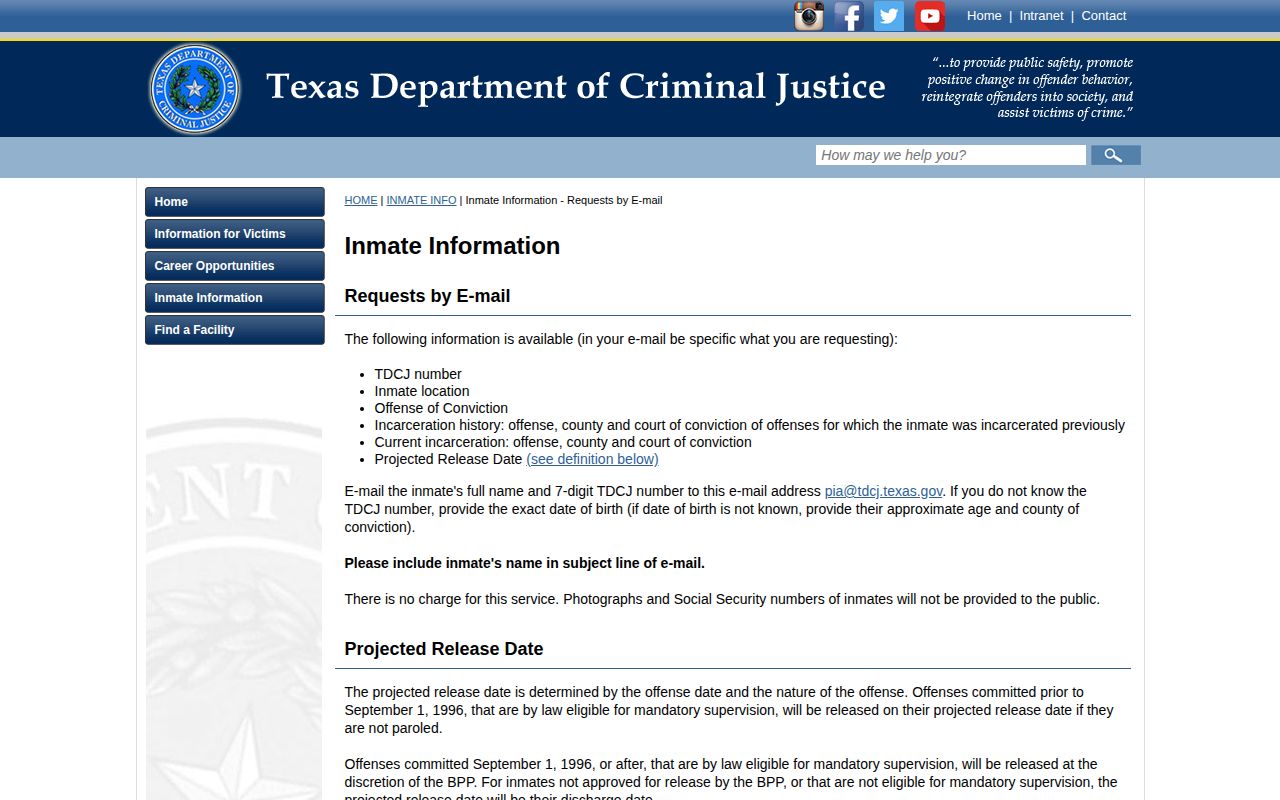
The captured source shows why the official TDCJ label must be quoted and why the field should not be converted into a guaranteed departure date.
Floyd County Good-Time Rules
Texas uses different frameworks for state prison and county jail sentences. Government Code Chapter 498 governs TDCJ good conduct time. Credits affect classifications and release calculations, but they are a privilege rather than a guaranteed reduction of the sentence itself. Forfeiture and restoration rules can change the computation.
TDCJ broadly separates older mandatory-supervision-eligible cases, later eligible cases that require Board approval, and offenses that are not eligible for mandatory supervision. In an eligible case before September 1, 1996, flat time plus good time reaching the sentence may produce mandatory release if parole has not occurred. For an eligible offense on or after that date, the Board must approve discretionary mandatory supervision. A denial may move the projected date to maximum expiration.
There is no blanket Texas rule that every state prisoner serves 85 percent. Government Code Sections 508.145 and 508.149 create offense-specific eligibility rules. For many listed serious offenses, actual calendar time of one-half of the sentence or 30 years, whichever is less, generally controls, with stated minimums and exceptions. Other eligible cases may use actual time plus good conduct time reaching one-fourth of the sentence or 15 years. Eligibility never guarantees release.
Do not use a generic calculator. Offense date, exact judgment, statutory amendments, sentence stacking, and credits matter. TDCJ and the court record are the proper sources for a Texas prison calculation.
Receiving-Jail Floyd County Calculations
A Floyd County sentence may be administered by another county's jail. This is the distinctive local issue. Code of Criminal Procedure Article 42.032 permits a sheriff to grant good-conduct commutation for conduct, work, and compliance, with a deduction that may reach one day for each day actually served when no misconduct charge is sustained. “May” is critical. The statute does not compel every sheriff to apply the maximum.
No published Floyd County good-time policy was found, and Floyd has no operating jail to administer one. Obtain the receiving sheriff's written policy and person-specific calculation. Ask how pre-sentence credit, the judgment, misconduct findings, other causes, and detainers were applied. TDCJ credits must not be copied into a misdemeanor county-jail sentence.
Childress is a documented receiving destination in one recent Floyd Sheriff report, but not a universal destination. First obtain the transport record. Then ask the jail actually named in that record. If the custodian gives only a date, ask whether it is projected, scheduled, maximum, or a completed physical-release timestamp.
Note: A Floyd court sentence and a receiving sheriff's calculation should be read together because the judgment supplies authority while the jail applies custody credits.
What Changes Floyd County Release Dates
A release date can move for valid reasons. Record the old and new labels, the date each source was checked, and the agency responsible for the change. Do not silently replace one date with another.
| Factor | Possible effect | Source to verify |
|---|---|---|
| Good-time forfeiture or restoration | Moves a TDCJ calculation or affects county credit under the applicable policy | TDCJ Classification and Records or receiving sheriff |
| Board approval or denial | Can advance parole processing or reset mandatory-supervision calculations | Board decision and TDCJ release processing |
| New judgment or court order | Changes sentence, credit, bond, or authority to hold | Case court and jail records |
| Detainer or warrant | May cause transfer to another custodian instead of community release | Holding jail and issuing agency |
| Required program or release plan | Can delay scheduled physical departure after a favorable decision | TDCJ Review and Release Processing |
| Data refresh | Creates a delay between the real event and public display | Originating agency, not the portal timestamp alone |
Parole eligibility is only the point at which consideration may occur. A favorable vote may still require plan investigation, audit, certificate work, and a safe release location. Conversely, a projected maximum date can be preceded by parole if the Board grants it and processing is complete.
Weekend Floyd County Release Timing
No verified Floyd-specific weekend or holiday schedule exists. Ask the actual receiving jail about its release desk, property steps, detainers, transport, and whether a weekend affects processing. State law gives limited guidance but does not prove Childress County's practice or another receiving jail's pickup time.
Code of Criminal Procedure Article 43.13 generally places discharge of a county-jail sentence between 6 a.m. and 5 p.m. on the discharge day. It permits limited preceding-day credit and other routes under stated conditions. Read the current statute. It does not create an automatic early release.
For TDCJ, Government Code Section 501.016 permits release on the preceding workday when the date falls on a weekend or legal holiday. It also describes facts in TDCJ release or discharge papers, including the name, release date and reason, sentence served, and sentencing county. Those are state-prison rules, not receiving-county jail policy.
Confirm Floyd County Actual Release
Use the physical custodian's completed record. Ask for the stable booking or commitment identifier, exact end date and time, verbatim reason or code, and destination. If the destination is another agency, state that custody continued. If the destination is blank or coded, request a definition rather than guessing.
IVSS can alert a registrant to an agency-reported event, but its timestamp may trail the jail event and former detainees may disappear. The current Texas process is explained on the VINELink Release Check page, which directs users to IVSS. Notification is a lead. The jail or TDCJ record is the release evidence.
A narrow conclusion is the safest one: released to the community on the agency-recorded date and reason; released from one agency to a named custodian and still held; released from confinement to parole or mandatory supervision; or discharged from the sentence shown by the agency.
Public Record Search
Sponsored Results