
Trace ICE Custody Releases
The official ICE ERO contact page provides the federal follow-up channel when an online detainee search is unresolved.
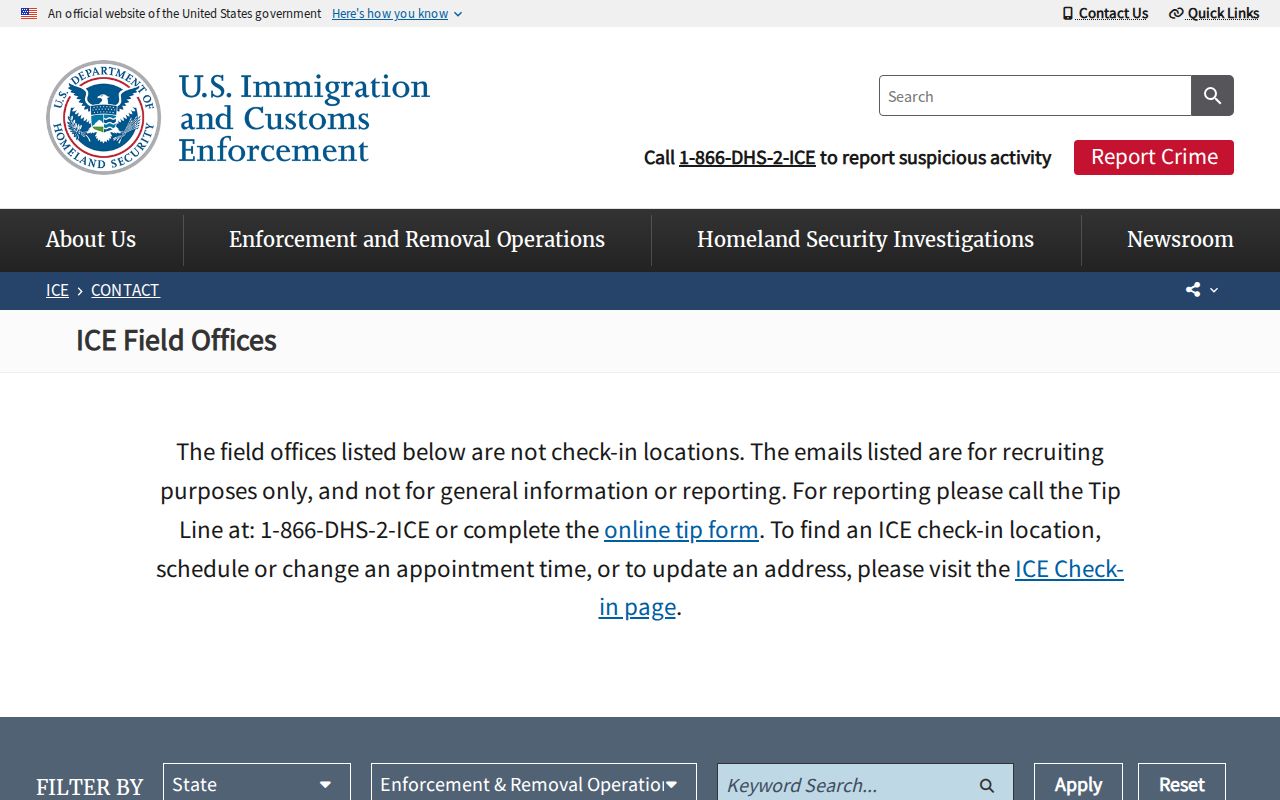
The contact route complements ODLS and does not turn a county transfer into a community release.
ICE detention is federal civil immigration custody. A Floyd or receiving-jail record may show that county custody ended because ICE accepted the person. That event is a transfer. The county release timestamp and ICE intake record should be joined so the end of one custody system is not mistaken for freedom from confinement.
ODLS can show certain people in ICE custody and limited recent release information, but coverage rules and data timing constrain the result. A person may also be outside the searchable population. Record the A-number, exact name, country of birth, event text, and date. Use ERO for a case the locator cannot resolve.
| Record holder | What it establishes |
|---|---|
| Floyd County Sheriff | Arrest and transport destination |
| Receiving jail | Admission, custody events, release time, reason, and destination |
| Case court | Bond, judgment, dismissal, sentence, or other legal order |
Search ICE Detainee Records
Start with the official ICE Online Detainee Locator System. Search with the A-number and country of birth when known, or use the biographical search fields. Spelling, compound names, and the limited released-history window can affect results. If the search is unresolved, use the ICE Enforcement and Removal Operations contact and provide the identifying facts allowed by that channel.
- Confirm that the county destination or detainer field names ICE.
- Search ODLS by A-number and country of birth when available.
- Try the biographical route with exact name forms when needed.
- Contact ERO if absence or an old event leaves custody unresolved.
- Keep county transfer time and ICE event time as separate facts.
The Floyd County released inmate search explains how the local handoff record connects to federal immigration custody. County IVSS coverage ends at the county system and cannot prove an ICE release.
Request ICE Custody Information
Begin with ODLS and ERO because those are the documented ICE access channels. Ask for the custody status, responsible field office or detention facility, and releasable event information. The Floyd Sheriff or receiving jail remains the source for the earlier county transport, release-to-ICE code, public detainer notation, and handoff time under Texas law.
ICE Enforcement and Removal OperationsFederal detainee information channel
888-351-4024
Use ODLS first when appropriate
If ERO cannot disclose historical detail, follow the federal records instructions it provides. Submit any Texas request for the county side only through that agency's designated Chapter 552 channel.
Floyd Handoffs to ICE
A 2025 Floyd County activity report documented a separate ICE handoff, making this branch locally relevant. It does not establish an ICE detention center or contract within Floyd County. Ask Floyd for the receiving authority, time, destination, and public detainer or transport data. Then continue through ICE rather than treating the county event as release.
Closure split the record trail. Floyd documents the local arrest and outbound transport. Another county documents detention and release. The Floyd court may hold the durable bond, judgment, dismissal, commitment, or sentence record after a jail interface changes. This explains why one phone call or one name search can produce an incomplete answer.
Read ICE Release Results
An ICE result should be tied to the A-number when possible. Preserve the exact custody or release event text, facility or field office shown, and event date. Locator absence can reflect the limited released-history window, a data mismatch, or coverage limits. It is not affirmative proof that ICE released the person or that immigration proceedings ended.
- Release to community
- The custodian records that confinement ended without naming a next jail or agency.
- Transfer
- Physical custody moved to another authority; confinement did not end.
- Discharge
- The sentence or supervision obligation shown by that system ended.
- Detainer
- A request or legal basis for another authority to assume or retain custody.
A court order and a jail timestamp answer different questions. The order can authorize release, set bond, dismiss a charge, or impose a sentence. The jail record shows when staff carried out the custody event. Keep both dates when they differ and label each precisely.
Follow Floyd Transfer Destinations
If the destination is TDCJ, use the statewide offender search and TDCJ information channels. Transfer to a prison unit is not a county release. Parole or mandatory supervision later ends confinement while supervision continues; discharge means the obligation shown by TDCJ ended. No TDCJ prison unit was identified within Floyd County.
For federal custody, use the BOP locator only when the person entered the federal prison system. A county handoff to ICE requires the ICE locator or Enforcement and Removal Operations contact. The U.S. Marshals Service does not provide a public prisoner locator comparable to BOP. In each branch, the next custodian's record controls what happened after Floyd or the receiving county ended its custody.
Note: Do not infer a present location from an old destination; confirm the complete chain with each named custodian.
When ICE Search Shows Nothing
An ODLS absence is not an affirmative release result. The person may fall outside the locator's searchable population, appear under a different name form, have a data timing issue, or be beyond its limited released-history window. Recheck the A-number and country of birth. For a biographical search, preserve compound surnames and exact spelling before concluding that no record exists.
Next, contact ERO through the official detainee-information route. Provide the identifying data and the county handoff facts supported by the Floyd or receiving-jail record. Ask whether ICE accepted custody, the facility or field office responsible, and what releasable event information is available. Do not publish private contact information or protected case details obtained through notification or family channels.
Immigration custody is separate from a Texas criminal case. A county court disposition can end or change the local charge without proving ICE release. Likewise, an ICE event does not by itself explain the county judgment. Preserve both systems' records. A precise conclusion might say the person transferred from the county to ICE, was released from ICE on an agency-recorded date, or could not be located through the public tool and requires ERO confirmation.
Keep the county booking or transport number beside the A-number, but do not treat them as interchangeable. If ERO names a detention site, confirm the next event with that ICE channel. When officials provide only a coded or partial answer, preserve the wording and ask for its meaning. The absence of a verified Floyd ICE contract makes case-specific confirmation essential.
A county release sheet may say “ICE” without naming the later detention site. That supports the handoff, not a present location. Ask for the destination or responsible field office, then document the answer with its date. If ODLS later shows no result, preserve both facts instead of erasing the earlier transfer. The records may describe different points in the custody chain.
Use the county event time and the ICE response time as distinct fields. A gap can reflect transport, intake, or a data update rather than release. When the immigration record remains unavailable, the safest conclusion is limited to the verified county handoff. Do not infer removal, community release, or present detention from silence in the public locator.
Public Record Search
Sponsored Results