
Trace TDCJ Release Status
The official TDCJ offender search shows the statewide controls used for current prison records.
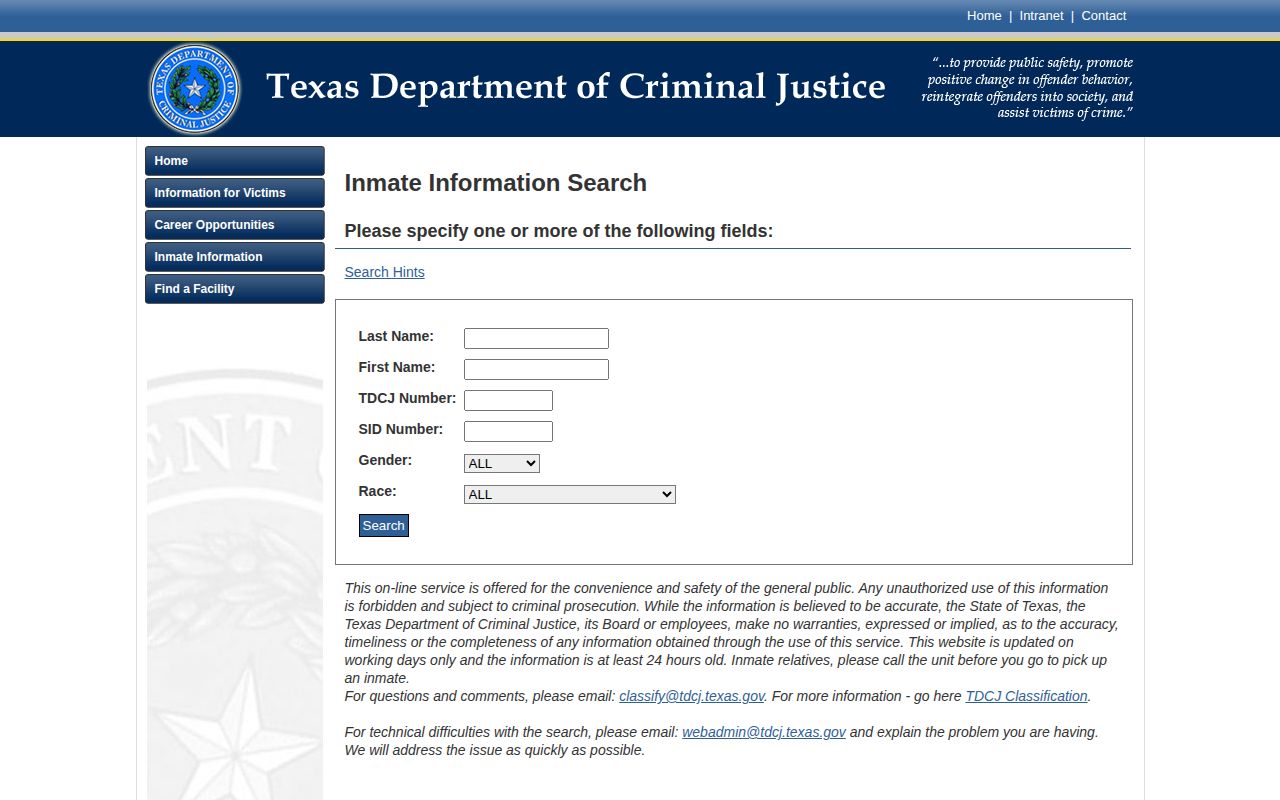
The search screen is a starting point; former or missing records still require a TDCJ information channel.
TDCJ custody begins after a court judgment and county-to-state transfer. That transfer does not release the person. Once TDCJ accepts the commitment, the statewide prison record becomes the main source for location, offenses, projected release information, parole eligibility, and later release status. Floyd County and the receiving jail still hold the earlier arrest and transfer trail.
Texas distinguishes parole, mandatory supervision, and discharge. Parole and mandatory supervision release a person from confinement under continued supervision. Discharge means the sentence or supervision obligation shown by TDCJ has ended. A projected date is an estimate, not proof that release occurred. Confirm the actual event through TDCJ information or records channels.
| Record holder | What it establishes |
|---|---|
| Floyd County Sheriff | Arrest and transport destination |
| Receiving jail | Admission, custody events, release time, reason, and destination |
| Case court | Bond, judgment, dismissal, sentence, or other legal order |
Search TDCJ Offender Records
Use the official TDCJ Online Inmate Search. Search by TDCJ number or SID when known; otherwise use the name and available sex and race fields. TDCJ states that public results cover people currently incarcerated and are at least 24 hours old. A missing name does not establish discharge or community release. Use TDCJ's email, telephone, or records channels for former records.
- Search by TDCJ number or SID before relying on a name match.
- Compare the full name, county of conviction, offense, and court.
- Read location, projected release, and parole eligibility as separate fields.
- Use the information line or email route when the former record is absent.
- Request the release history if the public result cannot prove the event.
The Floyd County released inmate search explains how the earlier county commitment connects to TDCJ. Statewide IVSS supports prison and parole notifications but does not replace the TDCJ release record.
Request TDCJ Release Records
TDCJ provides free email and telephone information channels before a formal request is needed. Ask with a narrow person and date range for the TDCJ number, unit history, conviction offense and court, projected date, parole eligibility, actual release information, supervision status, and discharge information available in the record. Government Code Chapter 552 governs Texas public-information requests, subject to lawful exceptions.
TDCJ Inmate InformationStatewide Texas service
936-295-6371 or 800-535-0283
Monday-Friday, 8 a.m.-5 p.m.
Send a request only through a delivery method currently designated by the agency. The Texas Attorney General request guidance explains that a government body may require its stated submission channels. No local copy price was verified. Ask for a written estimate under the applicable state cost rules instead of assuming a fee.
Floyd Transfers into TDCJ
Floyd County's jail closure makes the commitment path longer. A local arrest may first go to a receiving county jail. After conviction and commitment, that jail may transfer the sentenced person to TDCJ. Neither transport is a community release. Match the Floyd transport record, county jail transfer code, court judgment, and TDCJ number to avoid breaking the chain.
Closure split the record trail. Floyd documents the local arrest and outbound transport. Another county documents detention and release. The Floyd court may hold the durable bond, judgment, dismissal, commitment, or sentence record after a jail interface changes. This explains why one phone call or one name search can produce an incomplete answer.
Read TDCJ Release Fields
TDCJ information can include the TDCJ number, current unit, current and prior incarceration offenses, conviction county and court, projected release date, parole eligibility date, and release information available for the record. A TDCJ detail can distinguish current CID custody from parole or mandatory supervision. It is not a complete history of every Texas county-jail booking.
- Release to community
- The custodian records that confinement ended without naming a next jail or agency.
- Transfer
- Physical custody moved to another authority; confinement did not end.
- Discharge
- The sentence or supervision obligation shown by that system ended.
- Detainer
- A request or legal basis for another authority to assume or retain custody.
A court order and a jail timestamp answer different questions. The order can authorize release, set bond, dismiss a charge, or impose a sentence. The jail record shows when staff carried out the custody event. Keep both dates when they differ and label each precisely.
Follow Floyd Transfer Destinations
If the destination is TDCJ, use the statewide offender search and TDCJ information channels. Transfer to a prison unit is not a county release. Parole or mandatory supervision later ends confinement while supervision continues; discharge means the obligation shown by TDCJ ended. No TDCJ prison unit was identified within Floyd County.
For federal custody, use the BOP locator only when the person entered the federal prison system. A county handoff to ICE requires the ICE locator or Enforcement and Removal Operations contact. The U.S. Marshals Service does not provide a public prisoner locator comparable to BOP. In each branch, the next custodian's record controls what happened after Floyd or the receiving county ended its custody.
Note: Do not infer a present location from an old destination; confirm the complete chain with each named custodian.
Use Every TDCJ Record Channel
The online TDCJ search is useful but limited. TDCJ describes it as current-inmate information that is at least 24 hours old. If a former offender does not appear, use the no-charge inmate-information email instructions or telephone channel. Requests can seek the TDCJ number, unit, current and prior incarceration offenses, conviction county and court, projected date, parole eligibility, and available release information.
Projected release and parole eligibility are not actual release dates. Good-conduct time under Texas law can affect classification and eligibility, but it does not create an automatic release that a generic calculator can prove. Board review, holds, sentence changes, and administrative updates can alter the public estimate. Confirm a completed release through an agency event or record, then identify whether supervision continued.
TDCJ statewide IVSS can support prison and parole notifications. It remains a notification system, not the judgment or full discharge file. If the record shows parole or mandatory supervision, verify the active reporting office through TDCJ because residence approval and transfers can place supervision outside Floyd County. Use the formal TDCJ records route when the search, phone, email, and notification screens do not establish the historical event.
The Floyd court judgment and county transfer record remain useful matching sources. Compare the conviction county, court, offense, commitment date, and TDCJ number before attributing a statewide result to the local case. Keep a projected date, eligibility date, actual release event, and final discharge in separate fields. Each marks a different stage, and only the agency's completed event proves the stage occurred.
When dates conflict, retain each source date and ask TDCJ which field represents the final completed custody event.
A Floyd County conviction does not mean the person served time in Floyd County after sentencing. The county commitment and transport records establish when local control ended, while TDCJ establishes state admission and later release. Match those two systems by name, court, offense, identifiers, and dates. If TDCJ reports a release to supervision, keep the parole office and eventual discharge as separate later events.
Public Record Search
Sponsored Results