
Understanding Floyd County Releases
Floyd County released inmates do not come from an operating Floyd County jail. The local jail closed in 2003, and its former building was demolished in 2016. The Sheriff's Office still records arrests and transports, but a receiving county jail normally records the admission, custody events, and physical release. A Floyd County court separately records the bond, judgment, dismissal, sentence, or later order that supplied legal authority. Each record answers a different part of the question.
A person can leave one agency's roster without returning to the community. Bond, time served, sentence satisfaction, a court order, or dismissal may lead to release. A transport to another county, TDCJ, ICE, or the U.S. Marshals Service is a change of custodian. Parole and mandatory supervision release a person from confinement while conditions remain. Discharge usually marks the end of the sentence or supervision shown by TDCJ. These terms must stay separate.
- Time served
- A sentence satisfied by time already spent in custody.
- Parole
- Discretionary release from prison with supervision for the remaining term.
- Detainer
- A request or authority that may keep a person held for another agency.
- Discharge
- Completion of the sentence or supervision obligation shown by the issuing agency.
Floyd County Release Outcomes
The exact agency label matters. Abbreviations such as a transfer code should be quoted and checked against the agency's code legend. A bond order permits release after its conditions are met, but it does not show when jail staff completed processing. Likewise, a court dismissal may resolve a charge while another warrant still holds the person.
| Recorded outcome | What it means | Next record to check |
|---|---|---|
| Bond or court release | Physical release may follow once all conditions and holds clear. | Receiving jail release sheet and court order |
| Time served | The jail term was credited or completed. | Judgment, jail credit, and release timestamp |
| Transfer to TDCJ | County custody ended, but state imprisonment began. | TDCJ admission and current custody information |
| Transfer to ICE or USMS | Another federal custodian took control. | ICE or federal custody channel |
| Parole or mandatory supervision | Prison confinement ended under state supervision. | TDCJ release and parole information |
| Discharge | The stated sentence or supervision term ended. | Official TDCJ or court discharge record |
Only an affirmative record identifies the outcome. A name missing from a current list is not enough because removal can follow release, transfer, a data correction, or a routine system update.
Floyd County Release Record Fields
A useful release record ties one person to one custody event. Ask for stable identifiers and the destination, not just a name and a date. Floyd County may hold the arrest and transport portion while the receiving jail holds the booking number and physical-release event. Pairing those records prevents two people with similar names from being confused.
| Field | What it establishes |
|---|---|
| Booking or incident number | Connects the request to a distinct arrest or admission. |
| Arresting agency and date | Identifies the first custodian and event. |
| Receiving facility | Shows which jail accepted the person. |
| Booking and release timestamps | Marks entry and the end of that jail's physical custody. |
| Reason or disposition code | States bond, time served, court order, transfer, or another outcome. |
| Destination or detainer | Shows whether another agency took custody. |
| Charge, bond, and court | Connects the jail event with its legal case. |
The booking sheet may also contain physical descriptors, a photograph, charges, and bond information. A separate custody-history or release screen may carry the time and reason. Request both when the goal is to confirm how the Floyd County release occurred.
Ask for the agency's exact wording when the destination or reason is coded. “Released to TDCJ,” “released to ICE,” and “released to another agency” all end one jail's control while continuing custody elsewhere. A blank destination also needs follow-up. It should not be filled with a likely answer based on the charge, court result, or an older case involving the same person.
Request Floyd County Release Records
Texas Government Code Chapter 552 supplies the public-information framework. No fixed Floyd County fee, online request form, response time, or public display period was confirmed in the research. A narrow written request gives the custodian enough detail to locate the file and lets the office identify any cost or lawful exception before work proceeds.
- Give the full name, date of birth, approximate arrest date, arresting agency, and any case or incident number.
- Ask the Floyd County Sheriff's Office for the arrest file, transport log, destination, transport time, booking sheet, and any agency-held release data.
- Send the identified receiving jail a second request for admission, custody history, release time, reason code, destination, detainers, and booking photograph.
- Ask for electronic copies and a code legend. Request a cost estimate before copies are made if charges may apply.
- Compare both responses with the correct Floyd County court file. Keep each event date under its original label.
125 E. California Street
Floydada, TX 79235
806-983-4901
This is a Sheriff and records contact, not an operating jail.
Retention and online display are different. A record may remain in an agency schedule after it leaves a public interface. Expunction under Code of Criminal Procedure Chapter 55A or an order of nondisclosure under Government Code Chapter 411 can limit access. Juvenile and other confidential material may also be withheld. A denial should identify its legal basis.
Keep the request purpose-neutral and focused on an identified government record. If an office says it has no responsive record, confirm whether it searched the arrest system, transport log, and preserved jail-management data rather than only today's public view. The most useful reply identifies which fields exist, which office owns the next part of the chain, and whether any portion was withheld under a cited exception.
Courts Complete Floyd Release Chronologies
Floyd's split custody system often creates three matching files: the Sheriff's arrest and transport record, the receiving county's booking and release record, and the Floyd court's bond or disposition file. This is the distinctive local chronology. The court record may remain available long after a jail screen changes, but its order date cannot stand in for the moment the jail opened the door.
Use the Floyd County Clerk or District Clerk according to the court, or search statewide through re:SearchTX. Look for the case number, charging instrument, bond orders, judgment, jail-time credit, dismissal, sentence, and later orders. A judge may authorize release before administrative checks, property return, transport, or a second hold is resolved.
Find Floyd County Released Inmates
Start with the custody system, not a broad name search. Collect a full legal name, birth date, approximate arrest or admission date, known charge, case number, and any TDCJ, SID, jail, or BOP identifier. Then follow the branch that fits the case.
- Call Floyd County at 806-983-4901 and ask where the person was transported. The destination can change by case and bed arrangement.
- Contact that receiving jail and check IVSS-Counties for current custody. If the person is absent, request its historical booking and release event.
- Read the Floyd court file for release authority, sentence, dismissal, bond, jail credit, or another active cause.
- Search TDCJ if a prison transfer is possible. Use the BOP or ICE path only when the record points to federal custody.
- Verify supervision through TDCJ parole information or Floyd County CSCD, depending on whether the order is parole or probation.
- Request underlying records when an online tool lacks history. Match at least two independent identifiers before accepting a result.
A current roster answers who is held now. It is not a released-person archive. In Floyd County there is no local roster at all, and no official rolling release list was found. The records route therefore begins with the transport destination.
Identity checks matter throughout the search. Names and birth dates can collide, while photographs can be old or misleading. Compare a booking number, case number, TDCJ or SID number, arrest date, offense, and county whenever those fields are available. Two or three matching identifiers greatly reduce the risk of attaching another person's custody event to the Floyd County record being traced.
Join Floyd County Custody Records
The strongest Floyd County release check is a custody-chain join. First, obtain the destination in the Floyd transport record. Second, match that destination to the receiving jail's booking number. Third, read the receiving jail's release or transfer code and connect it to the court or next custodian. This method compensates for the lack of a local jail roster.
The 2025 Sheriff activity reports document at least one transport to Childress County. That is proof of a real destination in that case, not proof of an exclusive contract. Another Floyd County arrest may go elsewhere. A correct answer names the facility confirmed for the individual and does not relabel all Childress releases as Floyd releases.
When dates differ, keep them distinct. Arrest time, receiving-jail booking, the judge's order, jail release, and a later notification may all be accurate. Their labels explain why they do not match.
Floyd Release Search Through TDCJ
The TDCJ online inmate search covers people currently incarcerated in a TDCJ facility. It is not a Floyd County booking archive and does not preserve a public result for every discharged person. Search by TDCJ number or SID when known. A name search can add sex and race filters, then the result must be checked against age, offense, and county.
| Search field | Use | Key limit |
|---|---|---|
| Last and first name | Find candidates when no ID is known. | Surname matching is exact; a first initial can meet the minimum. |
| TDCJ number | Targets a state prison identity. | It is not a county booking number. |
| SID number | Targets the State Identification record. | Confirm the person before relying on it. |
| Gender and race | Narrows common-name results. | These are filters, not unique identifiers. |
TDCJ says the search is updated on working days and is at least 24 hours old. A missing result may mean no current TDCJ incarceration, a spelling problem, lag, county-only custody, or another system. For incarceration history and release or discharge information, use TDCJ's free email or telephone channel with the identity details requested by the agency.
The official search form shows the fields used for a Floyd County state-custody check. The TDCJ offender search source should be opened live before relying on an entry.
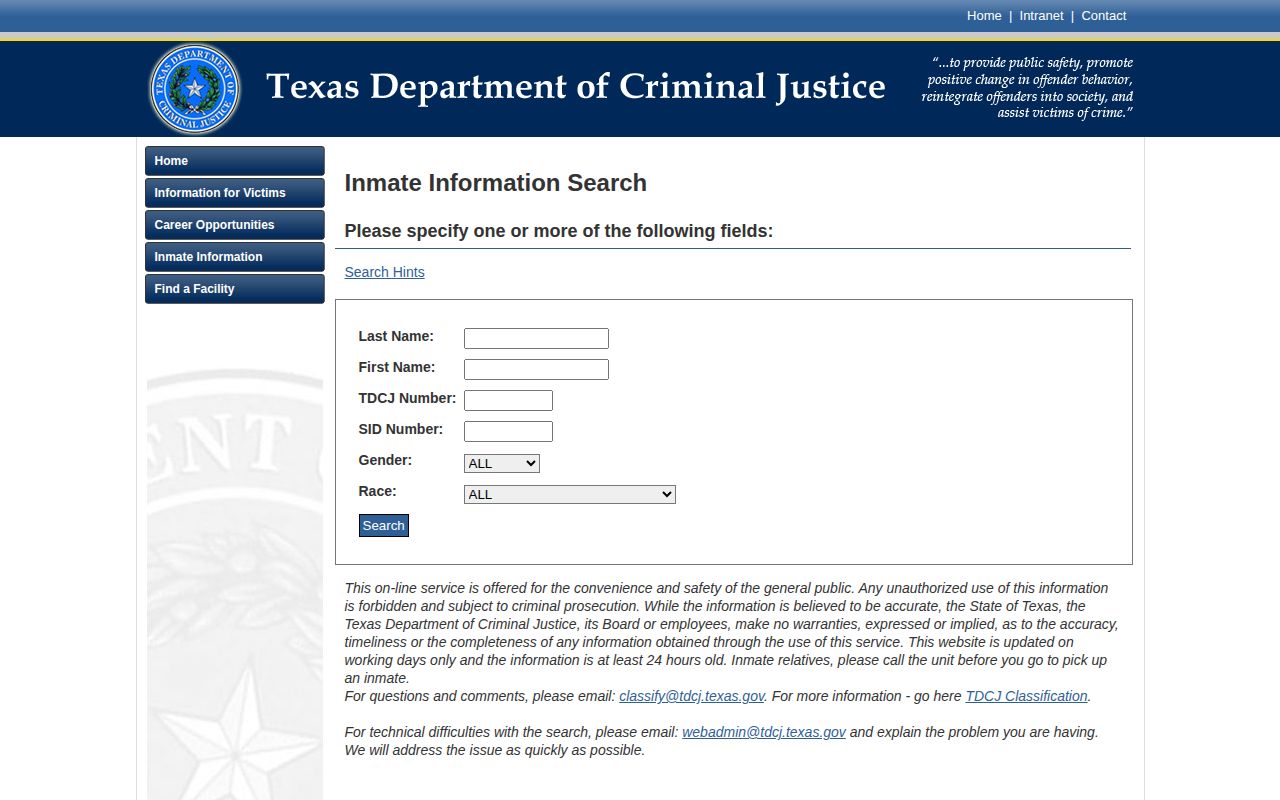
This captured form illustrates why a TDCJ or SID number is stronger than a name-only match and why the result belongs only to the state-prison branch.
Floyd Release Alerts and Transfers
Texas replaced county VINE service with IVSS-Counties on September 1, 2025. Search the current county portal by name or a supported DOC, SID, jail, or booking identifier. Check the reporting agency and event. The portal warns that it is not an official record and that a person no longer in custody may not appear. Floyd County participation was not conclusively verified, so confirm coverage in the live portal and with the receiving jail.
TDCJ has a separate statewide IVSS portal for prison and parole notifications. These two systems do not promise identical coverage. A notice may arrive after the physical event, and a reported release may still be a transfer. Preserve the notice, then obtain the release sheet and any stated destination.
For federal prison, the BOP Inmate Locator preserves many post-1982 records. A past release date or “RELEASED” means the person is no longer in BOP custody, but it does not resolve supervision or another agency's hold. ICE's locator is a different system. A Floyd County handoff to ICE ends county custody but is not a community release.
The U.S. Marshals Service does not supply a broad public prisoner-location search comparable to the BOP locator. When a Floyd transport record names a federal agency, preserve the exact agency and destination before choosing a locator. An ICE search result, BOP record, and county transfer entry describe different systems and should not be blended into one release date.
Where Floyd Release Status Appears
Choose the system that owned the event. Searching every portal without first identifying the custodian can produce a false negative or confuse a transfer with release.
| System | What it can show | What absence means |
|---|---|---|
| Floyd Sheriff | Arrest, transport, and destination records | It does not prove no receiving-jail record exists. |
| Receiving county jail | Admission, current custody, release, transfer, and destination | Request history before declaring release. |
| Floyd court | Bond, judgment, dismissal, sentence, and orders | It may not show physical processing time. |
| TDCJ | Current state incarceration, projected dates, parole, and records responses | The public search omits former prisoners. |
| BOP or ICE | Federal prison or immigration custody information | Each has coverage and history limits. |
Why did a person disappear? The cause may be community release, transfer, data correction, or system refresh. Only the affirmative event and destination resolve it.
Is Floyd County Jail Open?
No. The former jail closed in 2003 and its building was demolished in 2016. Online directories may still attach “Floyd County Jail” to the Sheriff's 125 E. California Street address. That address must be used as an agency and records contact, not as a promise of a walk-in roster, release desk, or detention facility.
The closure is practical, not just historic. A person arrested in Floyd County can generate records in several counties. The Sheriff identifies the receiving facility, and that jail owns its physical custody event. If the named facility will not give historical information by phone, send narrow requests to both offices.
Floyd County Release Custodians
The links below follow every custody branch identified in the Floyd County facility map. The first is the former local jail and current Sheriff contact. The next two cover documented or case-specific receiving county jails. TDCJ, BOP, and ICE apply only when the custody record points to those systems.
- Floyd County Sheriff's Office / Former Floyd County Jail, for arrest, transport, and agency-held records.
- Childress County Jail, a documented recent destination that must be confirmed case by case.
- Other Receiving County Jails, for a destination named in the Floyd transport record.
- TDCJ Correctional Institutions Division, for state prison custody and release records.
- Federal Bureau of Prisons, for federal prison records and released status.
- ICE Detention Network, for an immigration-custody transfer.
Never assume that one destination handled every Floyd County arrest. The individual transport entry controls the next step.
Public Record Search
Sponsored Results